The average at each tested age is about 100
Searches such as “average IQ by age” and “average IQ for a 12-year-old” often expect a table that maps calendar age to a lower adult-style number. That is not how current IQ scales are constructed. On an age-normed test, a 12-year-old is compared with other 12-year-olds. The midpoint of that comparison group is set to IQ 100—the 50th percentile by design. The same construction applies at other ages the test covers.
| Age | Average age-normed IQ | What that number is |
|---|---|---|
| 6 | 100 | Compared with other 6-year-olds in that test’s norms |
| 8 | 100 | Compared with other 8-year-olds in that test’s norms |
| 10 | 100 | Compared with other 10-year-olds in that test’s norms |
| 12 | 100 | Compared with other 12-year-olds in that test’s norms |
| 14 | 100 | Compared with other 14-year-olds in that test’s norms |
| 16 | 100 | Compared with other 16-year-olds in that test’s norms |
| Adult | 100 | Compared with the adult norm group for that edition |
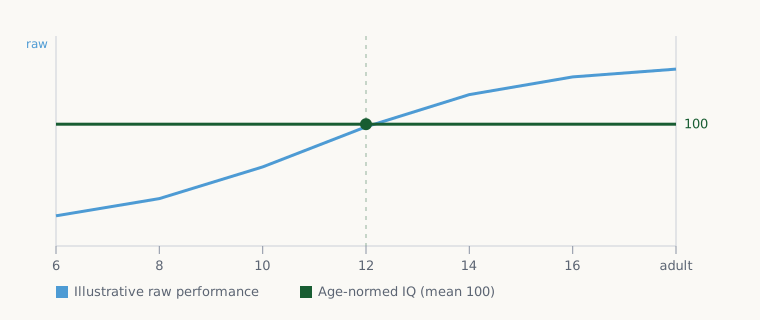
IQ Caddy does not publish a fabricated “IQ by age” census of children. A real score still belongs to a specific test, edition, and age band. Convert an already-standardized number with the IQ percentile calculator, or read ranges on the IQ scale and chart.
What is the average IQ for an 8-year-old?
About 100 on an 8-year-old’s age norms. An 8-year-old is not scored as a small adult.
What is the average IQ for a 10-year-old?
About 100 relative to other 10-year-olds in that test’s reference group.
What is the average IQ for a 12-year-old?
About 100. That is the midpoint of 12-year-old norms, not an adult-equivalent rewrite of a child’s raw score.
What is the average IQ for a 16-year-old?
About 100 on that age’s norms, for editions that still split adolescence from adult tables.
What is the average IQ for an adult?
About 100 on the adult norm group used by that test edition. See IQ 100.
Why age norms exist
Early ratio IQ used a mental-age idea: (estimated mental age ÷ chronological age) × 100. That formula is historical. It is not what this site’s calculator uses, and it is not how modern deviation IQ is scored.
Deviation IQ asks a different question: where does this performance sit among people of the same age on this test’s norms? Publishers scale that standing so the reference-group mean is 100 and, on many current instruments, the standard deviation is 15. The IQ bell curve on this site is that model—not a child’s raw item count plotted against adults.
Historical mental-age / ratio IQ
The widget below shows the old formula only. A 12-year-old with a “mental age” of 10 would print 83 as a ratio IQ. That is not how a current test would report an age-normed 12-year-old.
Raw scores, standard scores, and a common mix-up
Children typically solve more items as they develop. That change in raw performance is expected. The standard IQ score is then re-expressed against same-age peers so the average person at that age still lands near 100. Mixing those two quantities produces charts that look precise and are still the wrong kind of number.
| Quantity | What it is | What happens with age |
|---|---|---|
| Raw score | Items solved on that test | Usually rises through childhood as skills develop |
| Age-normed IQ | Standing versus same-age peers; mean set near 100 | Built so the average at each tested age stays near 100 |
| Adult-equivalent claim | A child’s score rewritten as if it were an adult IQ | Not how modern deviation IQ is scored; do not treat it as a census |
Does IQ change with age?
The honest answer splits the question. Raw ability is not frozen from age 8 to age 80. A standard IQ score, by contrast, is a relative position on an age-specific scale. For the average person in a test’s norm group, that position is constructed to be about 100 at each age the norms cover.
Whether a particular person’s standard score stays similar across years depends on the test, the interval, measurement error, and the research question. This page does not invent a points-per-year decline, a Flynn-effect table, or a lifetime trajectory. Those claims need their own sources. IQ Caddy’s calculator also does not age-adjust: it converts a supplied standard score on a mean-100, SD-15 normal model. Formulas are in the methodology.
Why two reports can disagree
Two scores for the same person can differ because the instruments differ. Edition, age band, ceiling, confidence interval, and practice effects all move the printed number. Official percentiles come from the publisher’s tables, not from a smooth curve on this site. A model percentile is a distributional conversion. It does not authenticate an online result or replace a score report.
Questions this page answers
- What is the average IQ for a 12-year-old?
- On a modern age-normed IQ test, the average 12-year-old is about 100 relative to other 12-year-olds in that test’s norms. That is how the scale is built. It does not mean a 12-year-old’s raw problem-solving matches a typical adult’s.
- What is the average IQ by age?
- For each age group a test is normed on, the average standard IQ is set near 100. Charts that assign children steadily lower “adult equivalent” IQs are not how current deviation-IQ scoring works.
- Does IQ change with age?
- Raw performance changes with development. A standard IQ score is scaled against same-age peers, so it is designed to stay near 100 for the average person at each tested age. Later-life change is a research question; this page does not invent a decline curve or a Flynn-effect table.
- Why is the average near 100 at every age?
- Deviation IQ is a relative standing, not a count of items correct. Publishers set the mean of the age-specific reference group to 100 (often with a standard deviation of 15). The number 100 is a midpoint on that scale, not 100 percent correct.
- What is the difference between a raw score and a standard IQ score?
- A raw score is how many items a person solved. A standard IQ score places that performance among same-age peers on a chosen test edition. Raw scores usually rise through childhood; the standard score is built so the average stays near 100.
- Can scores from different ages, tests, or editions be compared directly?
- Not as interchangeable numbers. Percentiles depend on the test, edition, age band, and score report. IQ Caddy’s calculator converts an already-standardized score on a mean-100, SD-15 model; it does not age-adjust raw items or reproduce a publisher’s table.